The Fascinating History of Sudoku: How a Global Phenomenon Was Born
When people look at a Sudoku grid, they often assume it is an ancient Japanese puzzle passed down through centuries. The name sounds traditional, and its elegant simplicity feels timeless.
However, the true story of Sudoku is a cross-continental journey spanning more than two centuries, linking an 18th-century Swiss mathematician, a retired American architect, a Japanese publisher, and a New Zealand judge.
1. The Mathematical Ancestor: Magic Squares and Leonhard Euler
The foundational logic behind Sudoku can be traced back to the legendary 18th-century Swiss mathematician Leonhard Euler.
In the late 1700s, Euler developed a mathematical concept called Latin Squares. A Latin Square is a grid where every symbol appears exactly once in each row and column.
While Euler’s Latin Squares did not feature the crucial 3 × 3 sub-grids that define modern Sudoku, they laid down the core rule of the game: numbers must never repeat on an axis.
2. 1979: The Missing Link in Indiana
The modern game of Sudoku was not invented in Tokyo. It was born in Connersville, Indiana.
In May 1979, Dell Pencil Puzzles and Word Games published a new brainteaser called “Number Place.” The puzzle used a standard 9 × 9 grid with the now-iconic 3 × 3 regions.
The puzzle was created anonymously, but historians later discovered that the creator was Howard Garns, a retired 74-year-old architect and independent puzzle maker. Garns took Euler’s Latin Squares and added box constraints, creating the exact mechanics we recognize today.
3. 1984: The Birth of the Name “Sudoku” in Japan
“Number Place” was a modest success in America, but it truly found its identity when it crossed the Pacific.
In 1984, the Japanese puzzle company Nikoli discovered the puzzle in an American magazine. Maki Kaji, the president of Nikoli, introduced it to Japanese readers.
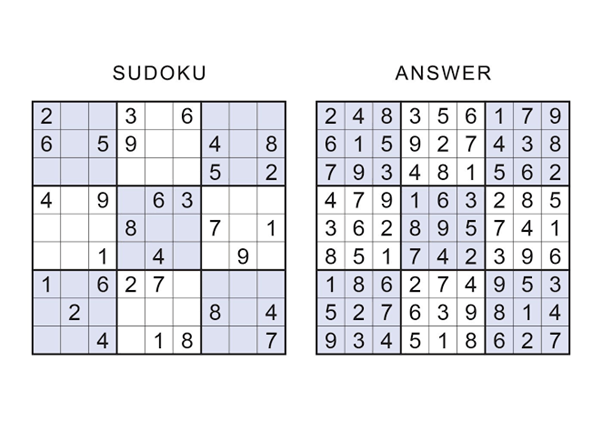
A classic Sudoku puzzle and its completed answer grid.
Initially, the puzzle was given a long descriptive title: Sūji wa dokushin ni kagiru, meaning “the digits must remain single.”
Kaji later shortened the phrase using the first kanji characters:
- Sū — meaning “number”
- Doku — meaning “single”
And just like that, Sudoku was born. Nikoli also introduced two design improvements: symmetrical placement of starting digits and cleaner puzzle layouts.
4. 2004: The British Invasion and the Global Boom
Despite its popularity in Japan throughout the late 1980s and 1990s, Sudoku remained relatively unknown in much of the world. That changed because of Wayne Gould.
Gould, a retired New Zealand judge living in Hong Kong, discovered Sudoku in a Tokyo bookstore in 1997. He became fascinated by it and spent years developing software that could generate unique Sudoku puzzles.
In late 2004, Gould pitched Sudoku to The Times of London. On November 12, 2004, the newspaper published its first daily Sudoku puzzle.
The response was explosive. Within months, newspapers across the UK, USA, Australia, India, and other countries were publishing Sudoku puzzles daily. By 2005, Sudoku books had become global bestsellers.
The Timeline of a Global Sensation
| Period | Event |
|---|---|
| 1780s | Leonhard Euler develops Latin Squares. |
| 1979 | Howard Garns creates Number Place in Indiana. |
| 1984 | Nikoli introduces the name Sudoku in Japan. |
| 2004 | Wayne Gould helps launch Sudoku into global newspapers. |
Why Sudoku Swallowed the World
Sudoku became popular because it is language-independent. It does not matter whether a player speaks English, Telugu, Japanese, German, or any other language. The logic of the grid is universal.
Today, platforms like Sudoku Multiverse continue that global tradition by offering new versions of the puzzle, including Kanji Sudoku, Royal Sudoku, and Color Sudoku.